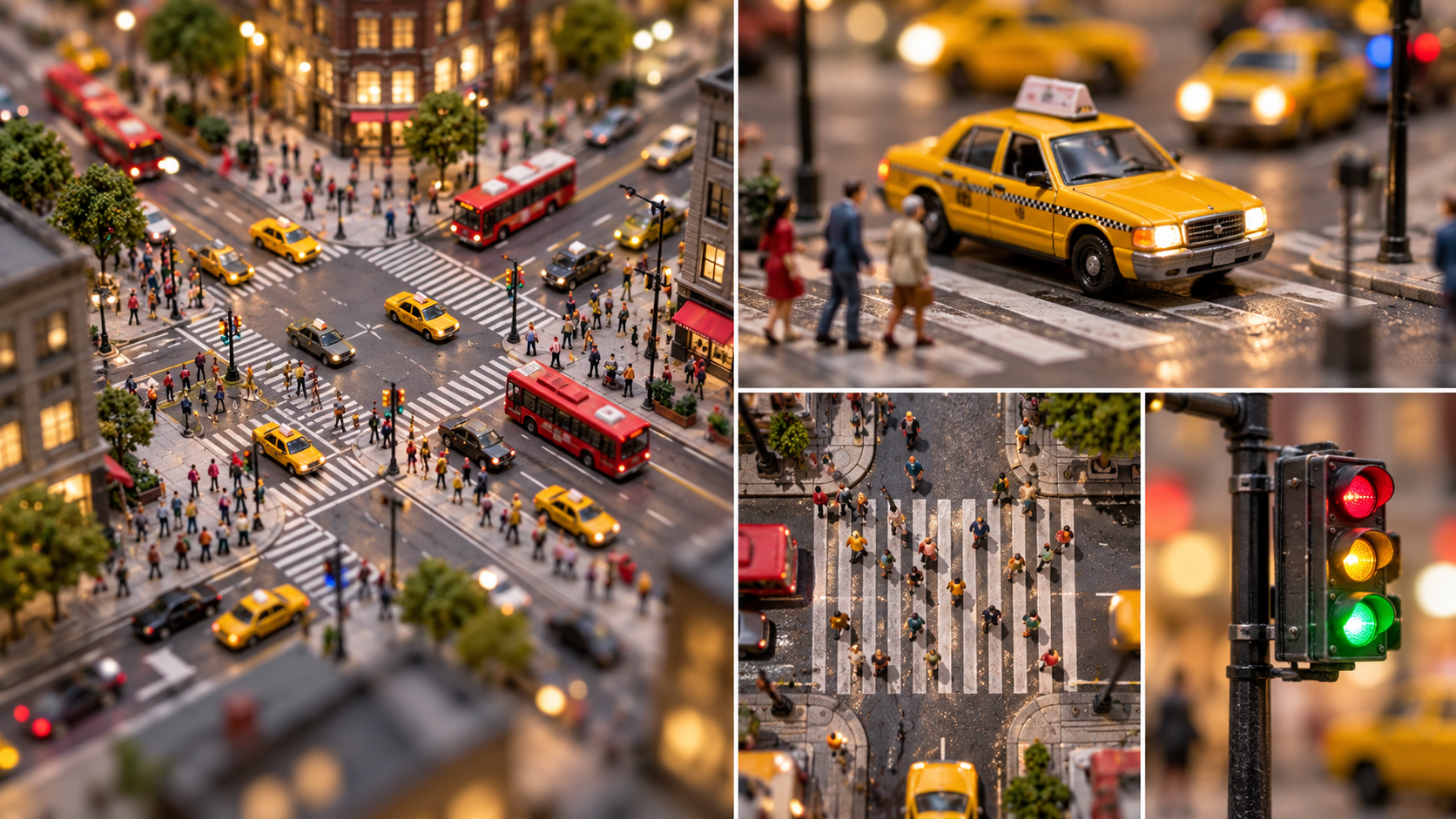
An enchanting tilt-shift diorama study of a bustling metropolitan intersection during morning rush hour, transforming speeding yellow taxis, double-decker buses, and pedestrian swarms into charming toy-like clockwork.
💡 Diffusion Conditioning Rule: Feed this sheet as Image 1 Reference (@image_1) in Seedance 2.0, Kling 3.0, and OpenAI Sora 2 to maintain 100% talent identity and product geometry across all cuts.
Miniature Metropolis — The Diorama Intersection
main_subject
Locked Continuity Anchors
Intricately detailed architectural scale model of a bustling 4-way city crossroads, featuring glossy yellow toy-like micro-taxis, red miniature double-decker buses, tiny plastic pedestrian figurines, and glowing miniature neon shop awnings.
Turnaround Reference Sheet Prompt
Professional 16:9 tilt-shift photography model sheet for Miniature Metropolis Crossroads: diorama scale model of a busy urban intersection, glossy toy-sized yellow taxi cabs, red micro buses, tiny painted pedestrian figures, miniature traffic lights with LED glows. Layout: 1) High-angle 45-degree isometric view with razor-thin horizontal focal plane and blurry top/bottom, 2) Close-up macro of tiny yellow cab at crosswalk, 3) Top-down view of pedestrian zebra crossing, 4) Miniature traffic signal box. Clean diorama studio display, authentic tilt-shift lens aesthetic, no watermark, no logo, no text.
One continuous storyboard project compiled into model-specific syntax, camera tags, and render instructions.
Seedance 2.5 Duration Mode:Choose between Hollywood multi-shot continuity standard and 30s single-pass master.
FORMAT: SEEDANCE · READY TO RUN
=== SEEDANCE 2.5 / DREAMINA HOLLYWOOD MULTI-SHOT PACK: Tilt-Shift Miniature Rush Hour Crossroads · 15s ===
Target Format: 16:9 | Block Unit: 10s-15s Hollywood Continuity Standard
[Seedance 2.5 Multi-Shot Execution Guide]
1. In Seedance 2.5, enable 'Reference Image' and upload the Character Turnaround Sheet as @[character ref].
2. Upload the corresponding storyboard frame as @[storyboard ref] to lock camera angle and subject blocking.
3. Input prompts block by block (10-15 seconds each) using the ending frame of block N as the starting frame of block N+1.
Global Story: An enchanting tilt-shift diorama study of a bustling metropolitan intersection during morning rush hour, transforming speeding yellow taxis, double-decker buses, and pedestrian swarms into charming toy-like clockwork.
Style Anchor: Authentic tilt-shift miniature photography, extreme optical shallow depth-of-field with sharp horizontal focal band, stop-motion stylized frame cadence, vibrant saturated diorama colors, 4k.
Character Anchors: Intricately detailed architectural scale model of a bustling 4-way city crossroads, featuring glossy yellow toy-like micro-taxis, red miniature double-decker buses, tiny plastic pedestrian figurines, and glowing miniature neon shop awnings.
[SEEDANCE 2.5 BLOCK 1 - 10-15s SEQUENTIAL UNIT]
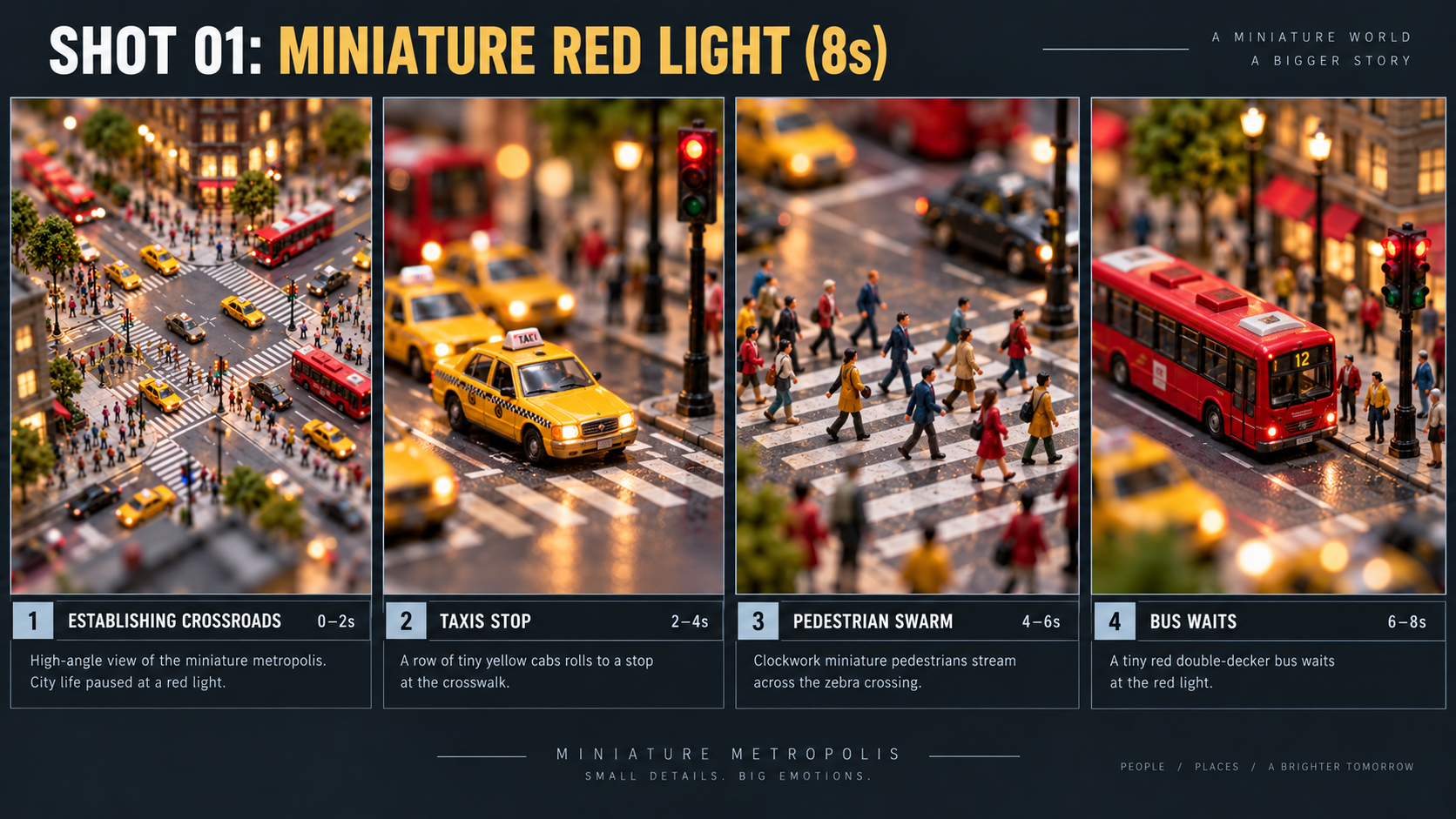
Goal: Establish the enchanting miniature aesthetic: traffic lights click red, toy cars pause in line, and tiny pedestrian figurines cross.
Camera: Static high-angle 45-degree tilt-shift perspective with intense selective focus on the central crosswalk
Lighting: Bright sunny morning diorama studio light with crisp tiny cast shadows
Action Beats:
0-2s: High-angle tilt-shift view: miniature traffic light clicks from green to amber to red. Camera: High-angle diorama static frame
2-4s: A line of glossy yellow toy taxis stops neatly at the white line with slight stop-motion wobble. Camera: Selective focus on front yellow taxi
4-6s: Hundreds of tiny painted pedestrian figurines march across the zebra stripes in brisk clockwork unison. Camera: Razor-sharp focal plane along crosswalk
6-8s: A tiny red double-decker bus waits patiently in the adjacent lane, reflections twinkling on its miniature glass. Camera: Subtle micro-pan across diorama intersection
Cut Handoff: Ending frame matches opening frame of Block 2.

[SEEDANCE 2.5 BLOCK 2 - 10-15s SEQUENTIAL UNIT]
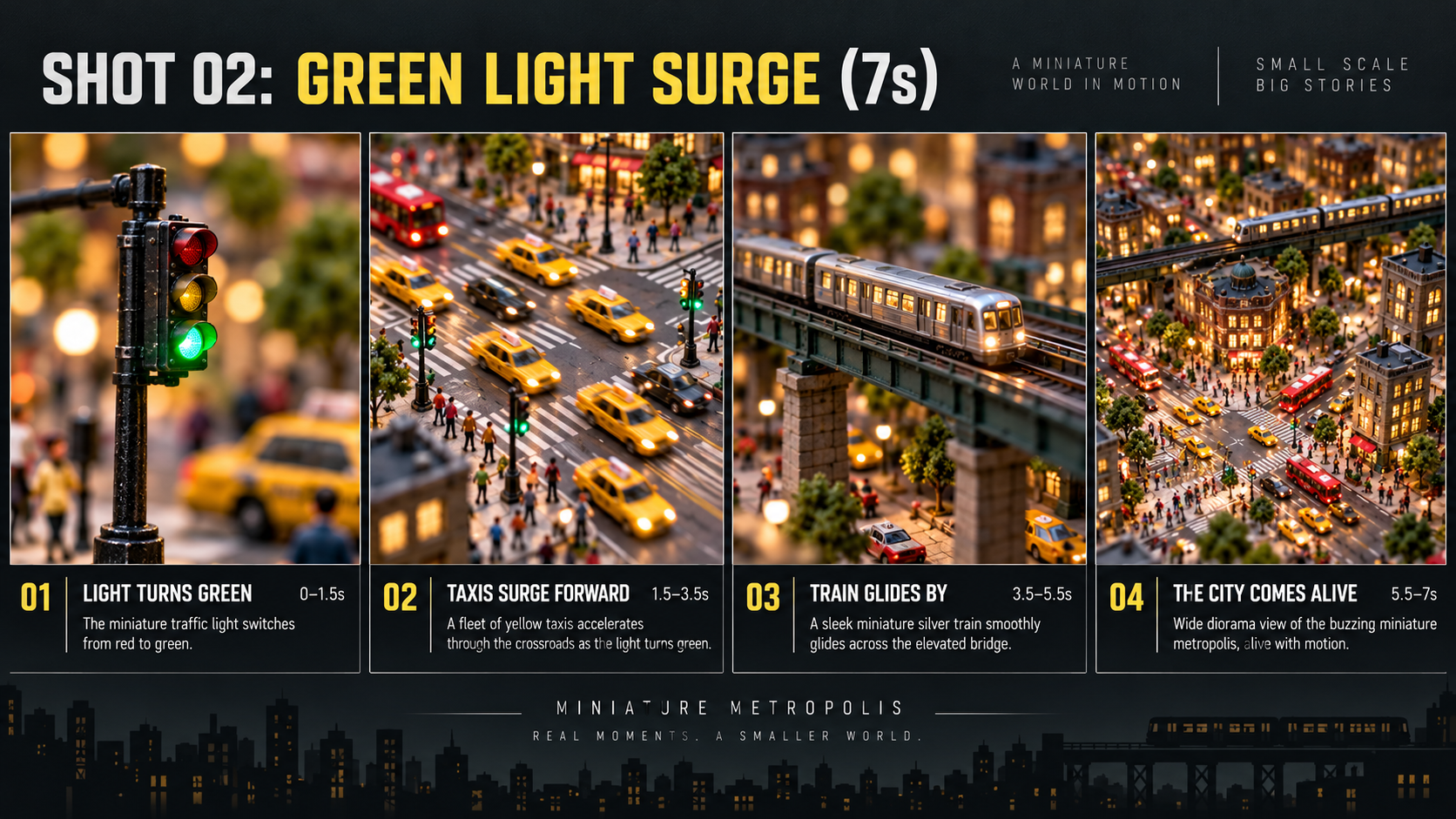
Goal: Direct kinetic handoff: traffic light turns green, the line of toy taxis surges forward in cheerful rhythm as an elevated train glides past.
Camera: Smooth high-angle lateral drift tracking with the flow of miniature vehicles
Lighting: Warm morning sun catching tiny windshields and metallic toy paint sparkles
Action Beats:
0-2s: Traffic signal clicks to vivid green; front yellow taxi's brake lights turn off. Camera: Tight selective focus on traffic light and cab
2-4s: The fleet of miniature yellow cabs and buses accelerates across the intersection like toy clockwork racers. Camera: Smooth panning drift pacing the moving toys
4-6s: On the overhead elevated track, a charming silver miniature bullet train glides smoothly across the frame. Camera: Tilting slightly up to capture miniature train bridge
6-7s: Wide diorama view holds as the morning miniature rush hour flows with harmonious, satisfying precision. Camera: Stabilized high-angle diorama master hold
Cut Handoff: Final scene hold / resolution — narrative payoff complete.
Quality Suffix: 4K, ultra HD, rich detail, sharp clarity, cinematic textures, stable picture.
Universal Continuity Law: The key to character and scene consistency across all AI video models is image conditioning. Save the Character Turnaround Sheet and Storyboard Grid above, then attach them as visual conditioning in Seedance 2.5 for studio-grade results!
// SEARCH INDEXING & PRODUCTION BLUEPRINT
Long-Tail SEO Keywords & Production Guide
Standardized prompt taxonomy and best practices for creating consistent multi-shot commercial AI videos.
Target Search Queries & Thematic Keywords
#Seedance 2.0 Continuity#Kling 3.0 Commercial Video#OpenAI Sora 2 Prompt#Multi-Panel Storyboard Reference#Character Turnaround Sheet#First Frame to Last Frame Seam Handoff#16:9 Cinematic Hollywood#Arri Alexa 35 Volumetric Lighting#Foley Audio Sync Direction#Tilt-Shift Miniature Rush Hour Crossroads · 15s AI Video Prompt
Director Continuity FAQ & Best Practices
How does multi-shot continuity work with Seedance 2.0 & Kling 3.0?
Multi-shot continuity uses a dual-anchor pipeline: first, a multi-panel Character Turnaround Sheet is passed as Image 1 Reference to freeze subject identity. Second, each shot block feeds the previous shot's final frame as its first frame, guaranteeing 100% seamless seam transitions without subject morphing.
Why use a storyboard grid image instead of pure text prompts?
AI video models often wander or change camera angles unpredictably when guided only by text. A 4-panel storyboard grid locks spatial geometry, lighting angles, and actor blocking, allowing models like Kling 3.0 and Sora 2 to follow explicit director camera coordinates.
How are audio SFX and rhythm synced across shots?
Each shot specification includes dedicated second-by-second audio foley direction (wind rustle, spritz, mist ambient swell). This makes it easy to generate synced sound in ElevenLabs, Suno, or Premiere Pro matching exact cut timestamps.
Can this prompt be used across multiple AI video engines?
Yes. The Universal Continuity syntax conforms to the standard reference architecture compatible with Seedance 2.0, Kling 3.0, OpenAI Sora 2, Runway Gen-3 Alpha, and Google Veo 3.